Bruges is often called a "medieval time capsule," and while the label isn't wrong, it undersells what's actually here. Yes, the Gothic and late-medieval fabric is extraordinarily well preserved. But Bruges is also a story of economic collapse turned architectural blessing: when the Zwin inlet silted up in the late 15th century and trade shifted to Antwerp, the city simply couldn't afford to tear down its old buildings and replace them. What survived is one of Europe's most complete medieval cityscapes, a place where the skyline has barely changed in five hundred years.
Look past the chocolate shops and canal boat tours, and you'll find a city of remarkable architectural sophistication. Bruges was one of the wealthiest places in Europe during the 13th through 15th centuries, a hub of international banking and the Flemish cloth trade, and its buildings reflect that confidence. The Belfry, the City Hall, the merchant houses along Jan Van Eyckplein: these aren't quaint relics but expressions of serious civic and commercial power. The brick construction that defines the city is itself a statement, as Flanders perfected brick Gothic to a degree unmatched anywhere in Europe.
What makes Bruges rewarding for architecture lovers is the consistency of its urban fabric combined with moments of genuine surprise. The medieval core operates almost as a single composition, with canals, bridges, and building facades working together. And then there's the Concertgebouw, a striking contemporary concert hall that proves Bruges isn't merely frozen in the past.
Architectural Timeline
Romanesque Traces (11th-12th Century)
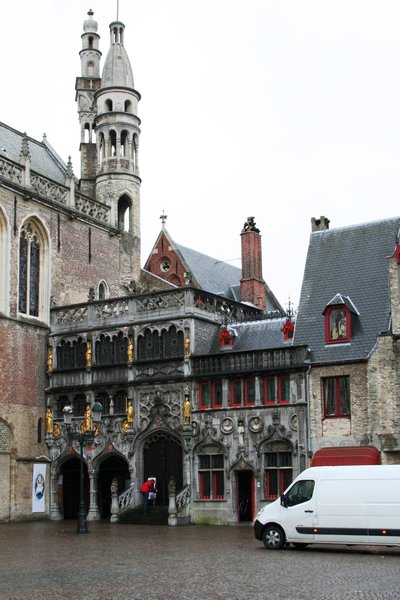
The oldest surviving architecture in Bruges dates to the Romanesque period, though most of it has been absorbed into later buildings. The lower chapel of the Basilica of the Holy Blood preserves a remarkably austere 12th-century interior, its heavy stone arches and barrel vaults a stark contrast to the ornate Gothic upper chapel added later. Sint-Salvatorskathedraal also retains Romanesque elements at its base, layered beneath centuries of Gothic rebuilding.
Gothic Splendor (13th-15th Century)
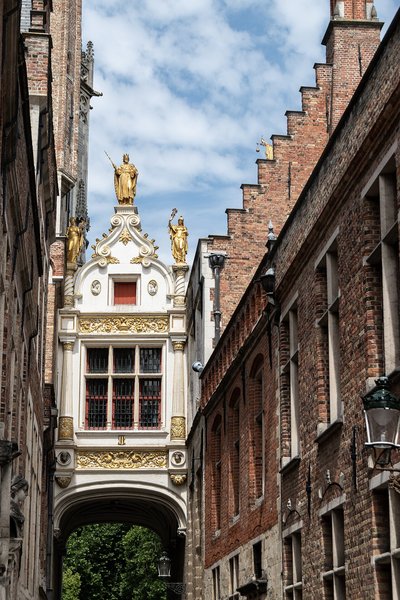
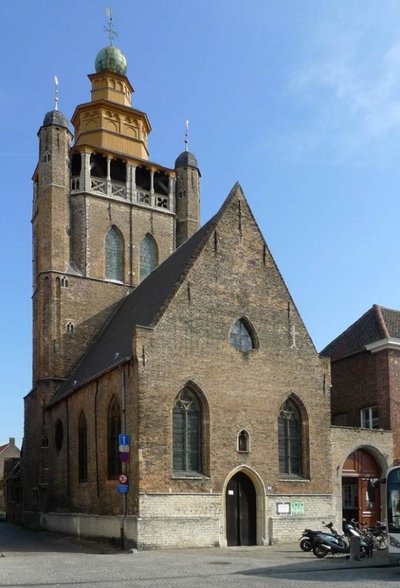
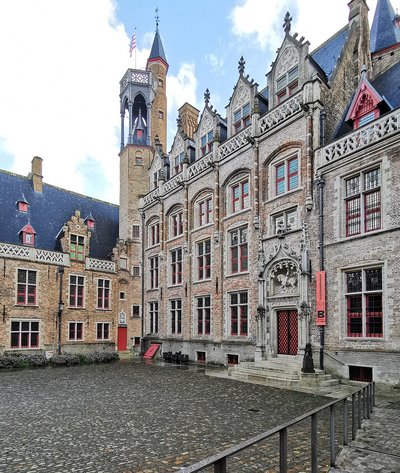
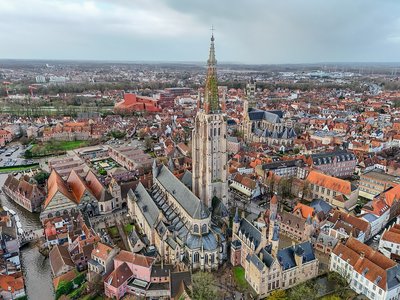
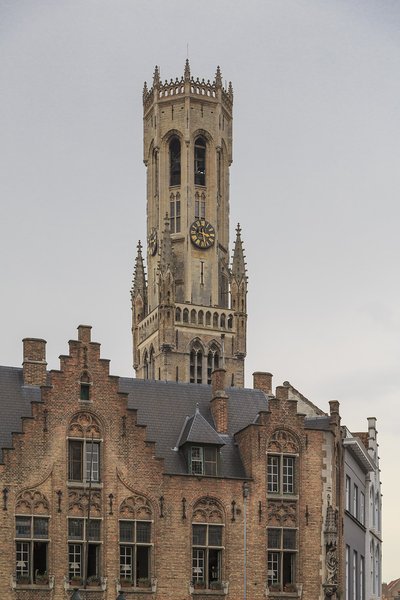
This is the period that made Bruges. The Belfry, begun in 1240, rises above the Markt as the city's civic symbol, its octagonal upper stage added in the 15th century. The Church of Our Lady holds the tallest brick tower in the Low Countries at over 115 meters, a staggering feat of medieval engineering. The City Hall, completed in 1421, established a template for civic Gothic architecture that was copied across Flanders and beyond. Jeruzalemkerk, built by the wealthy Adornes family after a pilgrimage to the Holy Land, is one of the most unusual churches in Northern Europe, its Jerusalem-inspired plan unlike anything else in Bruges. Hof Bladelin, Sint-Jakobskerk, and the Poortersloge all date from this golden age, each reflecting different facets of a city at the height of its wealth and influence.
Burgundian and Early Renaissance
The Brugse Vrije, seat of the Liberty of Bruges, shows the transition from Gothic to Renaissance in its remarkable carved chimneypiece, one of the finest Renaissance woodcarvings in Northern Europe. The Gruuthusemuseum occupies a patrician palace that bridges late Gothic and early Renaissance sensibilities, its intimate rooms giving a tangible sense of how Bruges's elite actually lived.
Neo-Gothic Revival (19th Century)
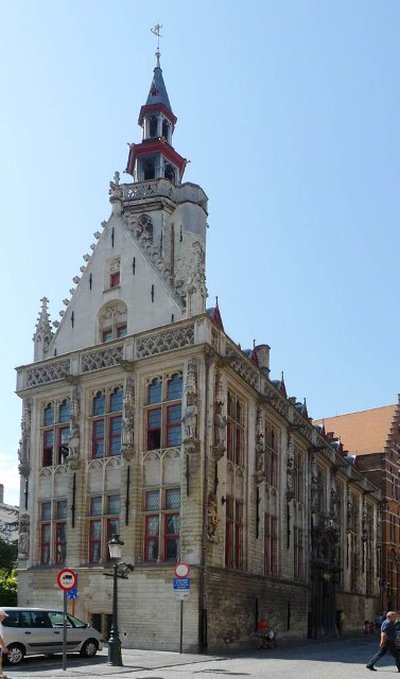
After centuries of quiet decline, Bruges reinvented itself in the 19th century through an ambitious program of neo-Gothic restoration and construction. The Provinciaal Hof on the Markt, built in the 1880s and 1890s, replaced earlier structures with a confident neo-Gothic palace that complements the medieval Belfry across the square. Much of what visitors experience as "medieval" Bruges was actually restored or rebuilt during this period, making the city an interesting case study in preservation philosophy.
Contemporary
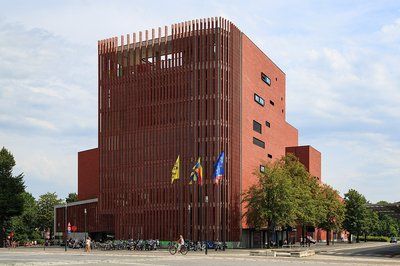
The Concertgebouw, completed in 2002 to designs by Paul Robbrecht and Hilde Daem, is Bruges's most significant modern building. Its terracotta-colored concrete tower rises near the railway station, a deliberate counterpoint to the Belfry. The building proved that Bruges could absorb contemporary architecture without losing its identity, though the debate it provoked says much about the city's relationship with its past.
Key Neighborhoods
The Markt and Burg
These two adjacent squares form the civic heart of Bruges. The Markt is dominated by the Belfry and flanked by the Provinciaal Hof and stepped-gable guild houses. The Burg, more intimate, holds the City Hall, the Basilica of the Holy Blood, and the Brugse Vrije. Together they offer a concentrated lesson in Flemish civic architecture across several centuries. Stand in the Burg and turn slowly: you'll see Romanesque, Gothic, Renaissance, Baroque, and Neoclassical elements within a single sweep.
The Canal District (Groenerei to Jan Van Eyckplein)
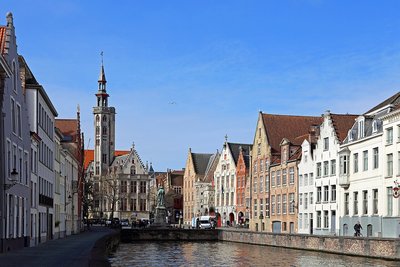
The canals north of the Burg hold Bruges's most photogenic streetscapes, but they're also architecturally significant. The merchant houses along Jan Van Eyckplein, including the Tolhuis (the old toll house), recall the city's trading connections. The Poortersloge nearby served as a gathering place for the city's wealthiest citizens. This area reveals how Bruges's architecture was shaped by water, commerce, and the practical needs of moving goods.
The Eastern Parish Churches
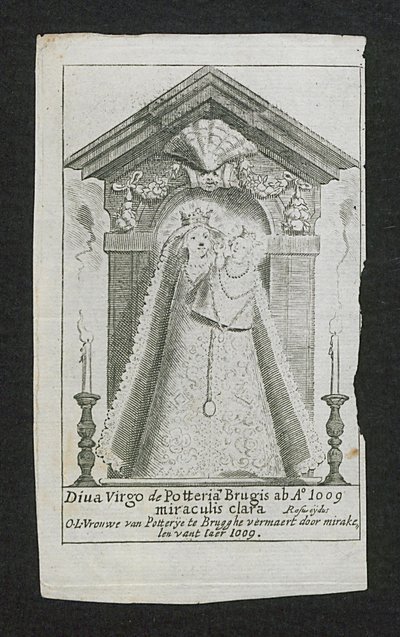
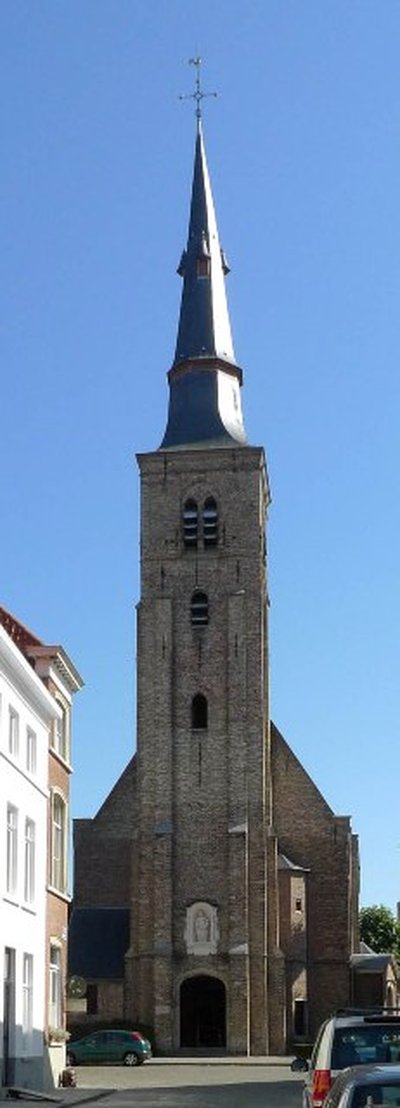
Beyond the tourist core, the neighborhoods around Sint-Annakerk and Onze-Lieve-Vrouw ter Potterie offer a quieter, more residential Bruges. Sint-Annakerk's simple Baroque interior is one of the city's hidden treasures, while Onze-Lieve-Vrouw ter Potterie, a former hospital chapel, preserves medieval and Baroque elements in an atmosphere of genuine calm. Jeruzalemkerk is also in this eastern quarter, its unusual profile visible from the surrounding streets.
Notable Architects
Jan van den Poele (14th Century)
Credited with the design of the City Hall, van den Poele established the template for Flemish civic Gothic architecture. The City Hall's elaborate facade, with its rows of niched figures and ornate window tracery, was enormously influential across the Low Countries. The building's Gothic Hall interior, with its polychrome vaulted ceiling, remains one of Bruges's great spaces.
Louis Delacenserie (1838-1909)
The architect most responsible for Bruges's 19th-century neo-Gothic revival. Delacenserie designed the Provinciaal Hof and oversaw the restoration of numerous medieval buildings. His work is sometimes criticized for over-restoration, but his sensitivity to Bruges's existing character helped establish the city's identity as a preserved medieval jewel.
Paul Robbrecht and Hilde Daem
The Belgian architects behind the Concertgebouw brought Bruges into the 21st century with a building that is respectful of context without being timid. Their terracotta tower acknowledges the brick tradition of Flemish building while insisting on a contemporary vocabulary. The building's interior acoustics and spatial generosity have won wide praise.
What to Notice
Study the brick. Bruges is a brick city, and the variations in color, bond pattern, and surface treatment tell you a great deal about a building's age and status. Medieval brickwork tends to be smaller in module and more irregular; 19th-century neo-Gothic work is more uniform. The Church of Our Lady's tower is a masterclass in what can be achieved with brick alone, its height and slenderness pushing the material to its structural limits.
Look at the stepped gables. The characteristic crow-stepped gable is Bruges's signature roofline motif, and you'll see hundreds of them. But notice the variation: some are purely decorative, others mark genuine structural gable walls. The rhythm of stepped gables along a canal or street is what gives Bruges its distinctive silhouette, and that rhythm was carefully maintained (and sometimes recreated) during 19th-century restorations.
Pay attention to the relationship between buildings and water. Bruges's canals aren't decorative; they were the city's commercial arteries. Warehouses have loading doors at water level. Bridges create natural gathering points and viewframes. The architecture makes sense only when you understand it as part of a water-based urban system.
Notice the scale. Bruges has almost no tall buildings apart from its church towers and the Belfry. The domestic architecture rarely exceeds three or four stories, creating a human-scaled city that feels intimate rather than imposing. This consistent low-rise character is one of the reasons the medieval atmosphere survives so effectively, and it's something you appreciate most when you arrive from a bigger city.